
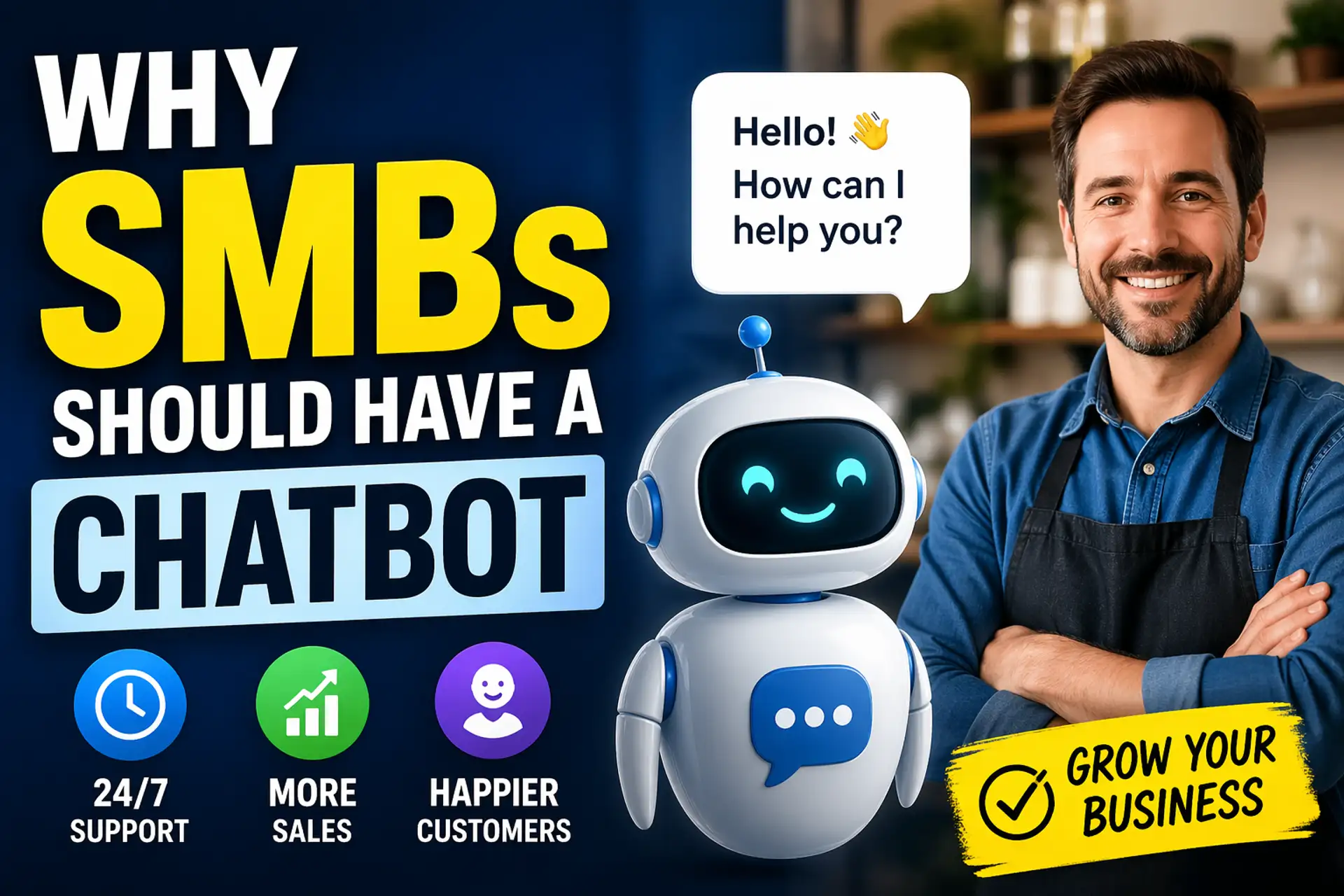
The Competitive Case for AI Chatbots: Why SMBs Need Business-Trained AI in 2026
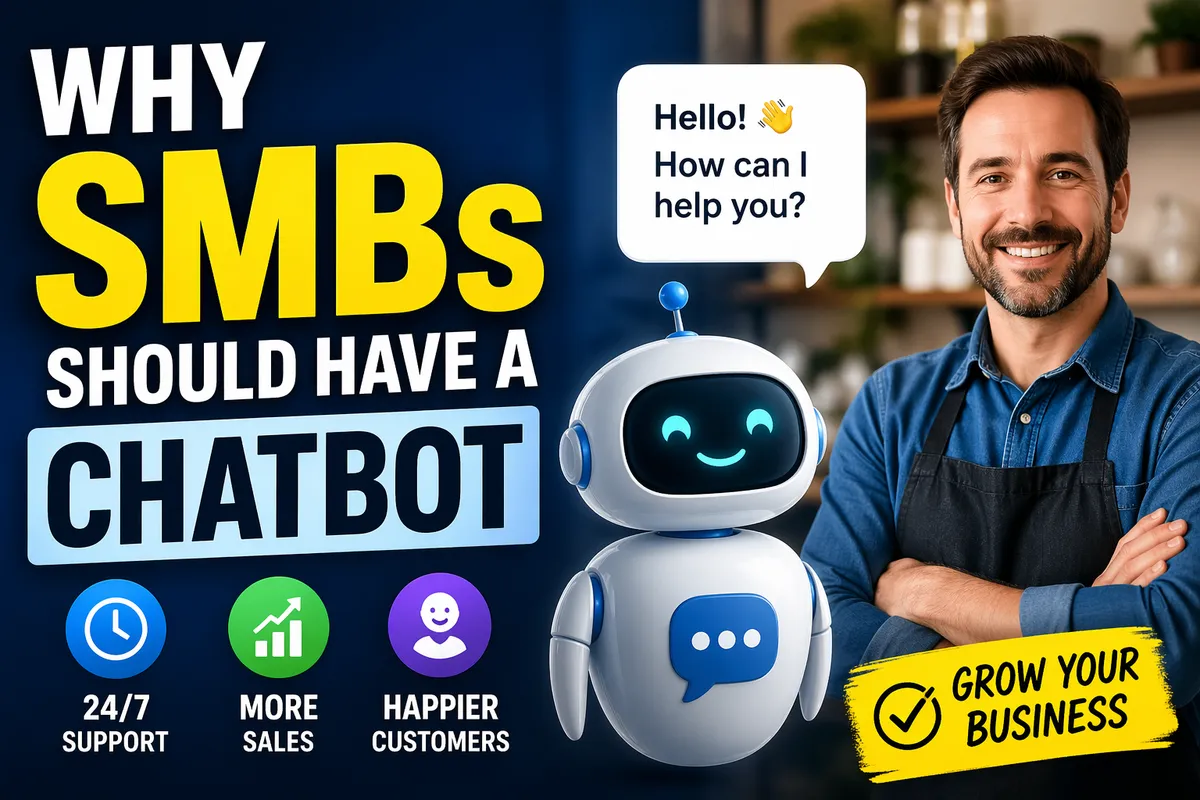
Executive Summary
The modern small and medium business (SMB) faces a paradox: customers expect enterprise-grade responsiveness around the clock, yet most SMBs lack the staff or budget to deliver it. Artificial intelligence - specifically, AI chatbots trained on a company’s own knowledge base - closes that gap at a fraction of the cost of additional headcount.
This white paper examines the business case for deploying a custom-trained AI chatbot. It covers the competitive pressures driving adoption, the measurable operational and financial benefits, the risks of inaction, and practical guidance on implementation. The conclusion is clear: for SMBs that want to grow without proportionally growing their payroll, an AI chatbot is not a luxury---it is a strategic necessity.
1. The Evolving Customer Expectation
Always-On Service Is Now the Baseline
A decade ago, a business that responded to inquiries within 24 hours was considered attentive. Today, that window has collapsed. Research by Salesforce consistently shows that the majority of consumers expect a response within minutes, not hours. Nearly a third expect an instant reply. For SMBs, meeting that expectation with human staff alone requires either significant overnight labor costs or accepting a competitive disadvantage.
KEY 74% of consumers say they are more loyal to businesses that can STAT answer questions in real time, regardless of the hour. (Salesforce State of the Connected Customer, 2024)
The Digital-First Buyer Journey
The majority of purchase decisions now begin online. Prospective customers visit a website, search for answers, compare options, and often make a buying decision before speaking to a human. If a business cannot answer questions at that critical research moment - evenings, weekends, holidays - the visitor moves on to a competitor who can.
An AI chatbot trained on a business’s specific products, services, pricing, policies, and FAQs is positioned at precisely this inflection point. It captures intent, answers questions, qualifies leads, and drives conversion - 24 hours a day, 7 days a week.
2. What Makes a Business-Trained Chatbot Different
Generic vs. Business-Specific AI
Not all chatbots are created equal. Generic chatbots offer scripted, rules-based responses that break down quickly when a customer asks anything outside a narrow decision tree. General-purpose AI assistants, while capable, have no knowledge of a specific business’s pricing, product catalog, store hours, service areas, or policies.
A chatbot trained specifically on a business’s own information - its website content, product descriptions, service manuals, FAQs, and internal knowledge base - operates at a fundamentally different level. It becomes a digital extension of the company itself, able to answer specific, nuanced questions with accuracy and brand consistency.
Capability Generic Chatbot vs. Business-Trained AI
Answers product-specific questions Limited / No vs. Yes, fully
Reflects current pricing & policies No vs. Yes
Maintains brand voice and tone No vs. Yes
Handles multi-step customer Rarely vs. Consistently journeys
Escalates intelligently to staff Basic vs. Context-aware
The Training Advantage
When a chatbot is trained on a business’s proprietary data, the result is a knowledge base that no competitor can replicate. The chatbot understands product nuances, local service considerations, common objections, and the specific language that resonates with that business’s customer base. Over time, this represents a genuine and growing competitive moat.
3. Measurable Business Benefits
Benefit 1: Reduced Operational Costs
Customer-facing communication - answering phones, responding to emails, managing live chat - is one of the most labor-intensive functions in any SMB. Studies from IBM and McKinsey consistently find that AI chatbots can handle between 60% and 80% of routine customer inquiries without human intervention.
For a business that employs one full-time customer service representative at the median U.S. salary of approximately $38,000 per year (plus benefits), deflecting even half of those interactions to an AI chatbot can represent tens of thousands of dollars in annual savings---while simultaneously improving response times.
EXAMPLE A regional HVAC company deployed a trained chatbot to handle scheduling inquiries, pricing questions, and service area confirmations. Within 90 days, inbound phone volume dropped by 41%, freeing technicians and office staff to focus on billable work.
Benefit 2: Lead Capture and Conversion
A website visitor who does not get an answer to their question does not wait---they leave. Bounce rates on SMB websites routinely exceed 50%, and a significant portion of that bounce is attributable to unanswered questions. A chatbot transforms passive website traffic into an active conversion tool.
By greeting visitors proactively, answering product questions in real time, and guiding prospects toward a purchase or appointment, a trained chatbot effectively becomes a 24/7 salesperson. Unlike a human salesperson, it never misses a shift, never has an off day, and simultaneously handles unlimited concurrent conversations.
Metric Typical Impact of Business-Trained Chatbot
Lead capture rate +20% to +35%
Website conversion rate +15% to +28%
Average response time < 3 seconds vs. hours
Cost per lead Reduced by 40—60%
After-hours inquiries converted Up to 70% retained vs. lost
Benefit 3: Consistent Customer Experience
Human customer service, however skilled, is inherently variable. Responses differ between staff members, vary by time of day, and degrade under high-volume conditions. A chatbot trained on a business’s knowledge base delivers a consistent, accurate, on-brand experience every single time.
This consistency is especially valuable for businesses with compliance considerations, regulated industries (insurance, healthcare, financial services), or premium brands where inconsistent communication erodes customer trust.
Benefit 4: Staff Efficiency and Morale
Repetitive, low-value inquiries - “What are your hours?” “Do you service my zip code?” “What does this warranty cover? - consume a disproportionate amount of staff time. By routing these queries to an AI chatbot, businesses free their human staff to focus on higher-value work: complex problem-solving, relationship building, and revenue-generating activities.
Beyond productivity, there is a morale dimension. Employees who spend less time on repetitive tasks and more time on meaningful work report higher job satisfaction - a relevant consideration in a tight labor market where SMB turnover remains costly.
Benefit 5: Scalable Growth Without Proportional Headcount
One of the most significant constraints on SMB growth is the linear relationship between revenue and staffing. As a business grows, so does the volume of customer inquiries, support requests, and administrative communications - typically requiring proportional increases in staff.
A chatbot breaks this linearity. Whether a business handles 50 customer interactions per day or 5,000, the marginal cost of each additional chatbot interaction approaches zero. This creates a scalable infrastructure that supports rapid growth without the hiring, training, and management overhead that would otherwise accompany it.
4. The Cost of Inaction
The Competitive Landscape Is Already Shifting
AI chatbot adoption among SMBs is accelerating. Businesses that deploy a well-trained chatbot today gain a first-mover advantage in customer experience within their local or vertical market. Those that wait will find themselves closing a widening gap - a gap that is not merely technological but experiential, in the minds of shared customers.
MARKET Adoption of AI customer service tools among SMBs grew by 38% DATA between 2023 and 2024. Analysts project continued double-digit growth through 2027. (Gartner SMB Technology Adoption Survey, 2024)
The Hidden Cost of Missed Inquiries
Every unanswered after-hours inquiry, every customer who bounced from a website with an unresolved question, every lead lost to a faster-responding competitor - these are invisible costs that never appear on a profit and loss statement but accumulate relentlessly. For businesses where the lifetime value of a customer is measured in hundreds or thousands of dollars, even a modest reduction in lost leads pays for a chatbot deployment many times over.
Customer Retention at Risk
Existing customers are not immune to competitive churn when service responsiveness declines. A customer who cannot get a quick answer to a support or billing question is a customer who begins evaluating alternatives. Proactive, instant chatbot support is not just an acquisition tool - it is a retention tool.
5. Implementation: What to Expect
How Business-Trained Chatbots Are Built
Modern chatbot platforms designed for SMBs abstract the complexity of AI training into a simple process. Typically, a business provides its website content, FAQs, product information, and any relevant documentation. The platform ingests and indexes this material, then applies large language model technology to create a chatbot capable of answering questions derived from that content.
Deployment is similarly streamlined. The finished chatbot is embedded on a business’s website through a single snippet of code - comparable in complexity to adding a Google Analytics tag. No ongoing IT infrastructure is required; the platform handles hosting, updates, and uptime.
Timeline and Effort
For most SMBs, the time from content submission to a live, deployed chatbot is measured in days rather than months. There is no software to install, no servers to provision, and no specialized technical staff required. The primary investment from the business is the time to gather and review the content that will be used for training.
Implementation Phase Typical Timeline
Content gathering and submission 1—3 business days
AI training and configuration 1—2 business days
Review, testing, and refinement 1—2 business days
Website deployment (single line of Under 1/2 hour code)
Total time to live Under 2 weeks
Ongoing Management
A well-designed chatbot platform requires minimal ongoing management. As a business’s products, services, or policies change, the chatbot’s knowledge base can be updated through the platform’s content management interface---no coding required. Most platforms also provide analytics dashboards showing common questions, escalation rates, and conversation outcomes, giving business owners actionable intelligence about what their customers are asking.
Integration with Existing Operations
Business-trained chatbots do not replace human staff - they work alongside them. When a customer’s question exceeds the chatbot’s scope, or when a prospect requests to speak with a person, the chatbot can seamlessly escalate the conversation, capturing context and contact information so that the human handoff is informed and efficient.
6. Addressing Common Concerns
”Our Customers Prefer Talking to a Real Person”
This concern is understandable, but the data suggests a more nuanced reality. Customers prefer fast, accurate answers. When a chatbot can provide those answers instantly - especially outside business hours - most customers are satisfied. The preference for a human interaction is strongest when issues are complex, emotional, or sensitive. A well-configured chatbot handles routine matters and routes the complex ones appropriately, giving customers the best of both.
”Our Business Is Too Specialized for AI”
The training-on-proprietary-data model directly addresses this concern. Because the chatbot learns from the specific business’s own content, it develops familiarity with industry terminology, unique product configurations, and the particular questions that arise in that business context. Specialty retailers, tradespeople, professional services firms, and healthcare-adjacent businesses have all found business-trained chatbots effective.
”What If the Chatbot Gives Wrong Information?”
Responsible chatbot platforms are designed to answer only from the content they have been trained on, and to acknowledge when a question falls outside their knowledge rather than speculate. Regular content reviews and a clear escalation path to human staff keep the risk of misinformation low. The relevant comparison is not “perfect AI” versus “perfect human” - it is the practical comparison between a well-configured chatbot and the current reality of missed calls, delayed email responses, and inconsistent staff answers.
”Is It Affordable for a Small Business?”
The modern SMB chatbot market is mature and competitive. Managed chatbot solutions designed for small businesses are available at price points that make the return on investment calculable within the first month of operation for most businesses. When the cost of even one deflected customer service hour per day is quantified, the economics are compelling.
Conclusion
The question facing small and medium businesses is no longer whether AI chatbots work - the evidence is substantial and growing. The question is whether a given business will adopt this capability now, while the competitive advantage is meaningful, or later, when it becomes merely a table stake.
A chatbot trained on a business’s own knowledge combines the efficiency of AI with the specificity of institutional knowledge. It is available when staff are not, consistent when humans are variable, and scalable in ways that human teams are not. For growing SMBs navigating the pressures of rising labor costs, heightened customer expectations, and intensifying competition, it represents one of the highest-return technology investments available today.
The businesses that will thrive in the next decade are those that find intelligent ways to do more with less - to deliver exceptional customer experiences without proportionally expanding their cost base. An AI chatbot trained on your business is a cornerstone of that strategy.
Ready to put your business knowledge to work 24/7?
Check out Bluesunrise AI chatbot builder. You can easily build your
chatbot. One line of code (we create for you) and you’re live.